

By the Media Aide to Adesina Lawal “King Dasilva”
At a time when conversations around the role of young people in Nigeria’s political development continue to gain momentum, Adesina Lawal, a politician, philanthropist and community leader, has called for a shift from symbolic youth participation to meaningful inclusion in political decision-making.

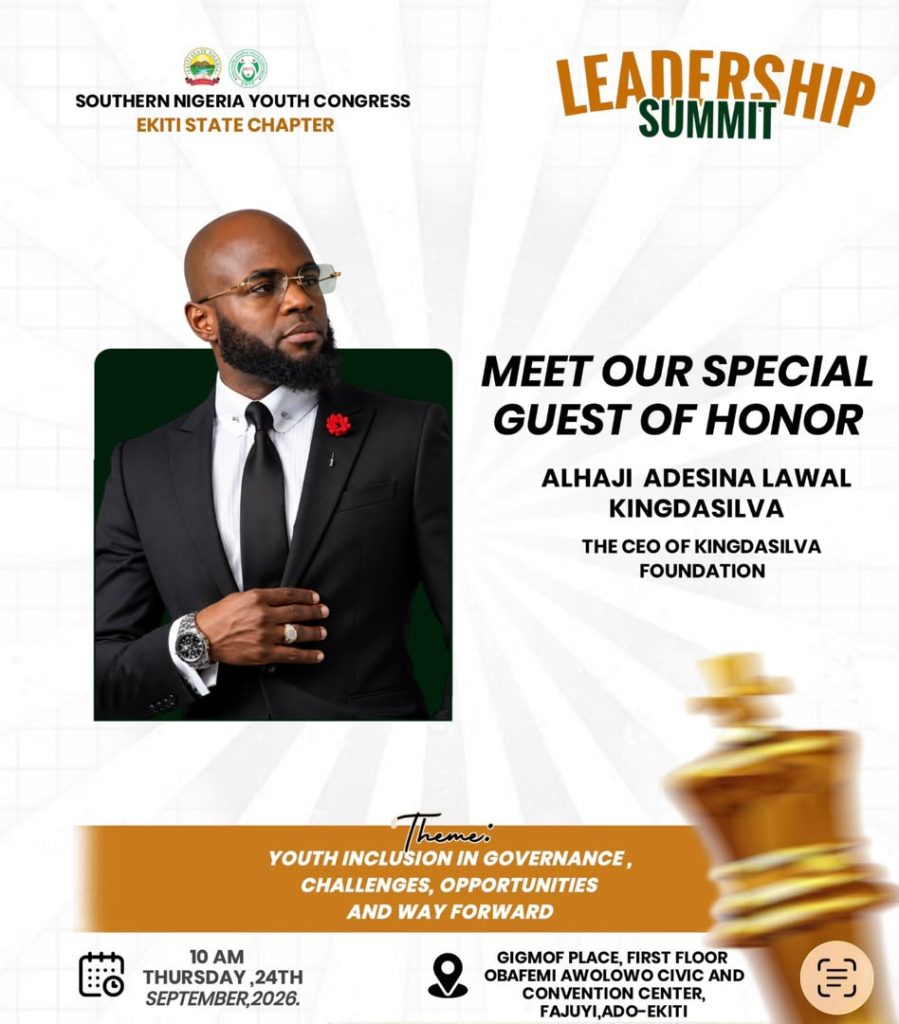
Lawal made the call while speaking on “Youth Inclusion in Politics: Challenges, Opportunities and the Way Forward” at a Leadership Summit organised by the Southern Nigeria Youth Congress, Ekiti State Chapter.
Addressing distinguished guests, community leaders and young Nigerians at the summit, Lawal described youth inclusion as an issue that goes beyond political campaigns, rallies and mobilisation. According to him, it concerns the right of young people to participate meaningfully in the processes where decisions affecting their future are made.
From Political Mobilisation to Decision-Making
Lawal observed that Nigerian youths have consistently demonstrated their importance to the political process. They participate actively in rallies, campaigns, political meetings and other activities, and their numerical strength makes them an important constituency in virtually every political contest.
However, he questioned why young people who contribute significantly to political mobilisation often find themselves absent when critical decisions are being made.
He argued that youth inclusion should not end at the campaign ground.
“Youth inclusion is representation, responsibility, and the right to sit at the table where decisions about the growth of the youth and the future of the nation are taken.”
For him, the conversation must therefore move from simply using young people as political foot soldiers to creating pathways through which they can contribute to governance, policy formulation and community development.
The Challenges Holding Young People Back
Lawal identified several factors that continue to discourage young Nigerians from seeking greater participation in politics.
The Cost of Politics
According to him, the financial demands associated with politics remain one of the biggest barriers facing young people.
Many youths who may possess the ideas, competence and willingness to serve are forced to ask whether they can afford the financial risks associated with political participation.
He noted that the perception of politics as a financially demanding venture has discouraged many young people who might otherwise have considered offering themselves for public service.
“Wait for Your Time”
Lawal also highlighted institutional and cultural barriers.
He criticised the recurring message that young people should “sit down,” “wait on the line” or “wait for their time,” arguing that such an approach can keep capable young people waiting for too long.
“If the youth are the future of tomorrow, the future is now.”
He stressed that preparing young people for leadership should not mean indefinitely postponing their participation. Instead, preparation should happen alongside practical opportunities to contribute.
The Crisis of Trust
Another challenge, he noted, is the growing distrust among young people resulting from unfulfilled political promises.
Statements such as “Your time is coming” and “You are the future of tomorrow” can lose meaning when young people repeatedly hear them without seeing tangible opportunities for participation.
Lawal argued that restoring confidence requires leaders to demonstrate through action that young people are genuinely valued in political and governance structures.
The Importance of Mentorship
For Lawal, mentorship is another critical component of youth political development.
He argued that the trajectory of a young person in politics can be significantly influenced by the quality of mentorship available to them.
Young people, he said, need mentors who are willing to guide them, open doors for them and provide opportunities without deliberately holding them back for personal interests.
He called for more selfless mentorship that focuses on building the next generation rather than creating political dependants.
The Opportunities Before Young Nigerians
Despite the challenges, Lawal maintained that the current generation of young Nigerians has enormous opportunities to contribute to the country’s development.
Bringing Fresh Ideas to Governance
He pointed to technological advancement, innovation, entrepreneurship and access to information as areas where young people can bring new perspectives into governance.
Young Nigerians, he noted, have opportunities to form teams, develop solutions, engage public institutions, challenge policies constructively and advocate for justice and fairness.
Their exposure to education, technology, travel and global networks can also provide useful perspectives for solving local problems.
Politics as a Platform for Personal Development
Lawal also described participation in governance as an opportunity for young people to develop themselves.
Being involved in the system, he explained, can provide practical knowledge about government, public administration, policymaking and community development.
The knowledge and experience gained can subsequently be used to contribute to society.
Creating Opportunities for Others
Beyond personal development, Lawal urged young people who eventually gain access to political and leadership spaces to remember those coming behind them.
He likened the process to breaking down a wall: when one person succeeds in creating an opening, others should be able to pass through.
If five young people gain meaningful opportunities and help twenty others, and those twenty help fifty more, a cycle of opportunity is created.
For him, this is one way to build sustainable leadership and expand access to opportunities within communities.
From Tokenism to Meaningful Participation
One of the strongest points in Lawal’s address was his call for political structures to move beyond tokenistic youth engagement.
He argued that young people are increasingly dissatisfied with being invited primarily for rallies, campaigns and mobilisation while having limited influence over actual decisions.
Meaningful participation, he said, should involve giving young people opportunities to contribute ideas, participate in decision-making, take responsibility and create measurable impact in their communities.
The objective, therefore, should not simply be to place young people in positions for appearances, but to equip them with responsibilities that allow them to contribute meaningfully.
Political and Civic Education Must Become a Priority
Lawal further stressed the importance of political and civic education.
Young people who aspire to participate in politics and governance need to understand how government works, how budgets are formulated and implemented, how policies affect citizens, and how public institutions function.
He called for more seminars, leadership programmes, civic engagements and practical training opportunities that can prepare young people for responsible participation.
According to him, young people cannot effectively demand accountability or participate meaningfully in governance if they do not understand the systems they seek to influence.
Young People Must Also Take Responsibility
While calling on leaders to create space for young people, Lawal also challenged youths to take responsibility for their own development.
He argued that not every challenge facing young people should be blamed on government.
Young Nigerians, he said, must build genuine networks rather than relationships based solely on personal friendships. They should join political parties where appropriate, ask questions, engage beyond social media, seek credible mentors, acquire useful skills and prepare themselves for leadership.
He emphasised that responsibility begins from everyday life — in the community, home, religious environment and workplace.
“Those who want to be trusted with the future must first prove themselves responsible.”
A Message to Today’s Leaders
In his closing remarks, Lawal addressed political and community leaders directly.
He clarified that the demand for youth inclusion should not be interpreted as a call for young people to disrespect or immediately replace existing leaders.
Rather, he said, young people are willing to learn, work alongside experienced leaders and benefit from their knowledge.
But that partnership, he argued, must also create room for genuine growth.
“We are not seeking to go shoulder-to-shoulder with or replace current leaders. We are ready to walk hand-in-hand with them, follow their path and give them full respect. But if we are the future of tomorrow, the future starts now.”
The message from the summit was therefore both a call to leaders and a challenge to young people: leaders must create meaningful pathways for youth participation, while young people must prepare themselves to responsibly occupy those spaces.
Lawal concluded by urging young Nigerians to build themselves, take responsibility and prepare for the opportunities ahead.
He prayed for the success of the dreams and aspirations of those present and expressed appreciation to the organisers and participants for their time and attention.
Adesina Lawal remains committed to promoting meaningful youth participation, leadership development and responsible engagement in Nigerian politics and governance.

1 comment
ADESINA LAWAL ON TOP