
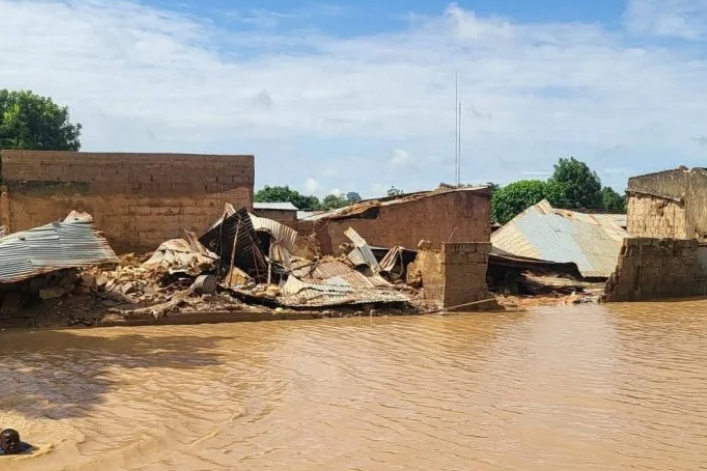
No fewer than 6.51 million Nigerians are facing an immediate flood threat as the 2026 rainy season hits its peak, the International Federation of Red Cross and Red Crescent Societies (IFRC) has warned.
The IFRC said floods could impact 151 communities, 49 schools, 46 health centres, 11 markets and 38 places of worship. Riverine and coastal areas are said to be the most vulnerable.The forecast is based on data from the Nigeria Hydrological Services Agency (NIHSA), NiMet and the IFRC’s West and Central Africa risk assessment. Because of the threat level, Nigeria has been classified as “High Risk Prepare.
”The IFRC has released 80,000 Swiss Francs, about N181 million, from its Disaster Response Emergency Fund to help the Nigerian Red Cross scale up early warnings, evacuation plans and community preparedness in 8 states.Peak expected August 1The report said floodwaters are projected to peak around August 1, with rising river levels and waterlogged soils increasing the chances of widespread inundation.“Current forecasts align with NiMet’s 2026 Seasonal Climate Prediction and IFRC risk analysis, which estimate 6.51 million people are exposed to imminent flood risk, especially in vulnerable riverine and coastal communities,” the document stated.NIHSA outlook: 250,000 sq km at riskNIHSA’s 2026 Annual Flood Outlook projects that 250,788 square kilometres of Nigeria could be flooded this year. Of that, 138,227 sq km — 55.1% — are high-risk zones likely to experience severe flooding.More than 14,000 communities across 266 LGAs in 33 states and the FCT are in the high-risk category.
Another 15,500 communities in 35 states fall under moderate risk.On July 14, NIHSA placed 13 states — Adamawa, Akwa Ibom, Anambra, Bauchi, Benue, Borno, Cross River, Edo, Enugu, Imo, Kaduna, Niger and Plateau — on medium flood alert after 16 hydrological stations recorded near-critical water levels. Localized flooding is also expected along the Karam, Waya and Amber rivers in Adamawa and Bauchi.Limited funds for direct interventionDespite the scale, the IFRC said available resources will allow direct support for only about 16,000 people in 16 priority LGAs across Adamawa, Akwa Ibom, Bauchi, Benue, Cross River, Edo, Lagos and Plateau.
These areas were picked based on vulnerability and poor access to existing early-action programs. A larger population will benefit indirectly through radio alerts, early warning campaigns and sanitation drives.The report noted that localized flooding has already hit parts of Lagos, Akwa Ibom, Bauchi and Plateau, showing that grounds are saturated ahead of the peak.
The Benue State Emergency Management Agency has also asked the Nigerian Red Cross for help in 9 high-risk LGAs, citing fears of displacement, loss of livelihoods, damage to infrastructure and worsening food insecurity.45-day emergency planThe 45-day operation will run August 1 to September 30 and will focus on: – Reducing flood deaths through early warning and evacuation – Protecting livelihoods – Preventing waterborne disease outbreaks – Training Red Cross volunteers to work with emergency agenciesThe IFRC reminded that Nigeria remains highly prone to seasonal floods.
The 2022 floods — the worst in over a decade — killed hundreds, displaced over a million people and destroyed property nationwide.It warned that 2026 flooding could worsen humanitarian conditions, especially in Adamawa and Benue where thousands of IDPs already live in fragile conditions due to conflict.
