
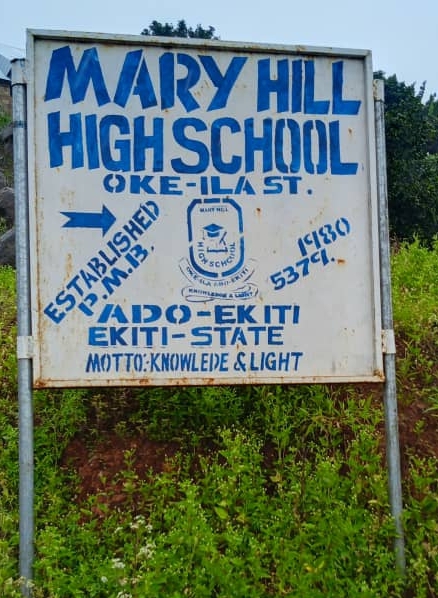
The Mature Mind Digital Radio Team made a visit to Maryhill High School, located at Okeila, Ado-Ekiti, the capital city of Ekiti State, nicknamed a Fountain of Knowledge in the South Western part of Nigeria. The Digital Media Team took a walk round the school on a save-our-soul call by the Alumni Association National Executive Committee on the deplorable state of the road leading to its Alma Mater.
At a time when access to quality education is increasingly recognised as a shared responsibility among government, communities, institutions, parents and alumni, the condition of the access road leading to Maryhill High School, Ado-Ekiti, deserves renewed public attention.
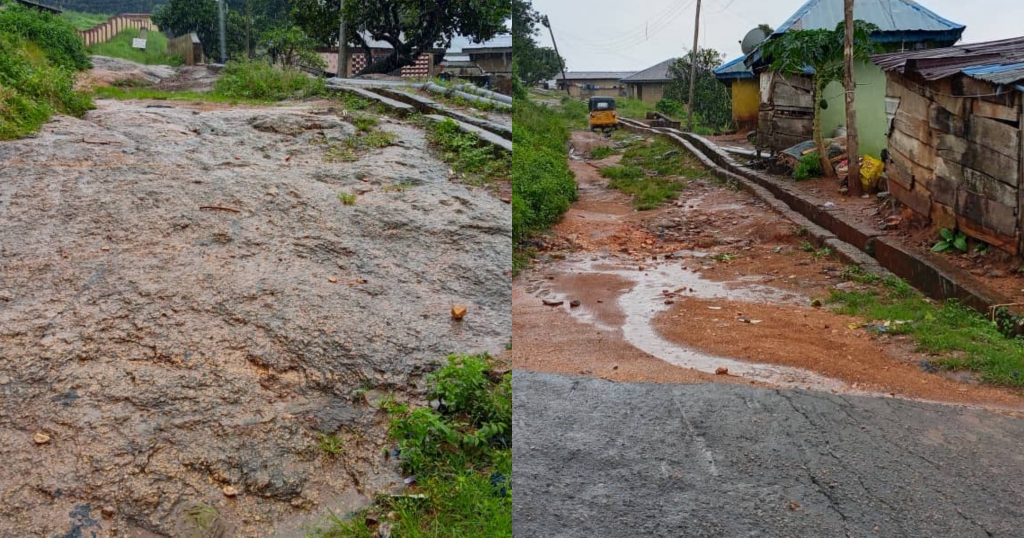
The road, which provides an important link between the school and surrounding communities, is at present in a condition that makes movement considerably difficult, particularly during periods of heavy rainfall.
The deteriorating portions, uneven surfaces and accessibility challenges raise legitimate concerns about the ease with which students, teachers, parents, visitors, service providers and members of the public can conveniently access the institution. In fact, it has always been a harrowing experience to the hills.
This is not an occasion for blame or confrontation. Rather, it is an opportunity to draw attention to a developmental need that calls for constructive intervention.Maryhill High School is part of the educational heritage of Ado-Ekiti that accommodates about 1000 students both boys and girls.
The school is listed among Ekiti State’s public secondary schools, while previous interventions have also recognised Maryhill Boys High School among institutions requiring support for educational development.
A Link Between the Gown and the Town
For a school community, an access road is not merely an infrastructure project. It is a pathway through which education, opportunity and social interaction are delivered.A difficult-to-navigate road can affect punctuality, transportation, emergency access, movement of school supplies and the general experience of students, staff and visitors.
For parents and members of the public who have legitimate business within or around the school, accessibility is equally important.Consequently, improving the road should be viewed as an investment in the educational ecosystem and the wider community, rather than simply a physical infrastructure intervention.
Alumni Taking Responsibility
One encouraging dimension of the situation is the commitment being demonstrated by the Maryhill Old Students Association, whose leadership has continued to show interest in the development and welfare of their alma mater.The Association is led nationally by its President, Prince Dare Daramola, with Mr. Kola Arogundade serving as Secretary-General, alongside other members of the National Executive Committee.
The Association’s interest in the school is consistent with the broader philosophy that alumni organisations can serve as important development partners in strengthening educational institutions. Indeed, Prince Daramola has publicly expressed support for infrastructure development in Ekiti State and called for sustained attention to road networks across the State.
That commitment provides a useful platform for constructive engagement around the Maryhill access road. The Alumni Association is not resting on its oars in ensuring a facelift to the school.
A Partnership Opportunity
The present condition of the road should therefore be approached as a partnership opportunity involving the State Government, relevant local authorities, the school community, residents, corporate organisations, philanthropists and the Maryhill Old Students Association even though the bulk stops on State Government table. .The immediate objective need not necessarily begin with an elaborate reconstruction project.
A carefully assessed intervention could determine the most appropriate and cost-effective solution-whether grading and drainage works, lateritic rehabilitation, stone-base treatment, asphalt surfacing or phased reconstruction.
What matters initially is to make the road safely passable and accessible, while developing a sustainable plan for its eventual improvement.Such an approach would also be consistent with contemporary development journalism, which does not merely identify problems but draws attention to practical solutions and encourages responsible stakeholders to act.
A Constructive Appeal
The appeal is simple: let the Maryhill access road become a development priority worthy of attention.There is no need for recrimination. There is no need to attribute blame. The issue can be addressed through constructive dialogue, technical assessment, stakeholder collaboration and a clearly articulated intervention plan.The relevant government authorities may consider undertaking an assessment of the road and determining the appropriate intervention required.
The Maryhill Old Students Association, for its part, could facilitate advocacy, stakeholder mobilisation and possible partnerships, while members of the community can support efforts to protect and maintain whatever intervention is eventually provided.
A modest but strategic intervention on the road could produce benefits far beyond the school gates. It would improve accessibility, support educational activities, facilitate movement and demonstrate what is possible when government, alumni and the community work together around a common development objective
The Bigger Picture
The Maryhill story should ultimately be about more than a bad road. It should be about what happens when a community identifies a development gap and chooses to pursue a solution collectively.The school has a history, a community and an alumni network with a demonstrated interest in its future.
The determination of the Maryhill Old Students Association’s National Executive Committee offers an important foundation upon which government and other stakeholders can build.The road leading to Maryhill High School should therefore not remain an impediment to access. It should become a pathway to renewed educational development.
What is required now is purposeful engagement, technical intervention and sustained collaboration-so that students can get to school more easily, teachers can work in a more accessible environment, parents and visitors can move conveniently, and the people of Ado-Ekiti can once again see the road as what it ought to be: a functional public pathway serving an important educational institution.
The time is right for action-not confrontation; partnership-not blame; and development-not delay!

1 comment
Good thank you for this please let us share this to reach government of Ekiti and all concerns Body the school access road need urgent attention,is one of the most important and effective way for good learning,as learning atmosphere requires good environment.i really appreciate Mary Hill alumni for their efforts so far please we are appealing to Ekiti government to intervene as quick as possible.