
Mon, 3 Aug 2026 | 6:35 AM
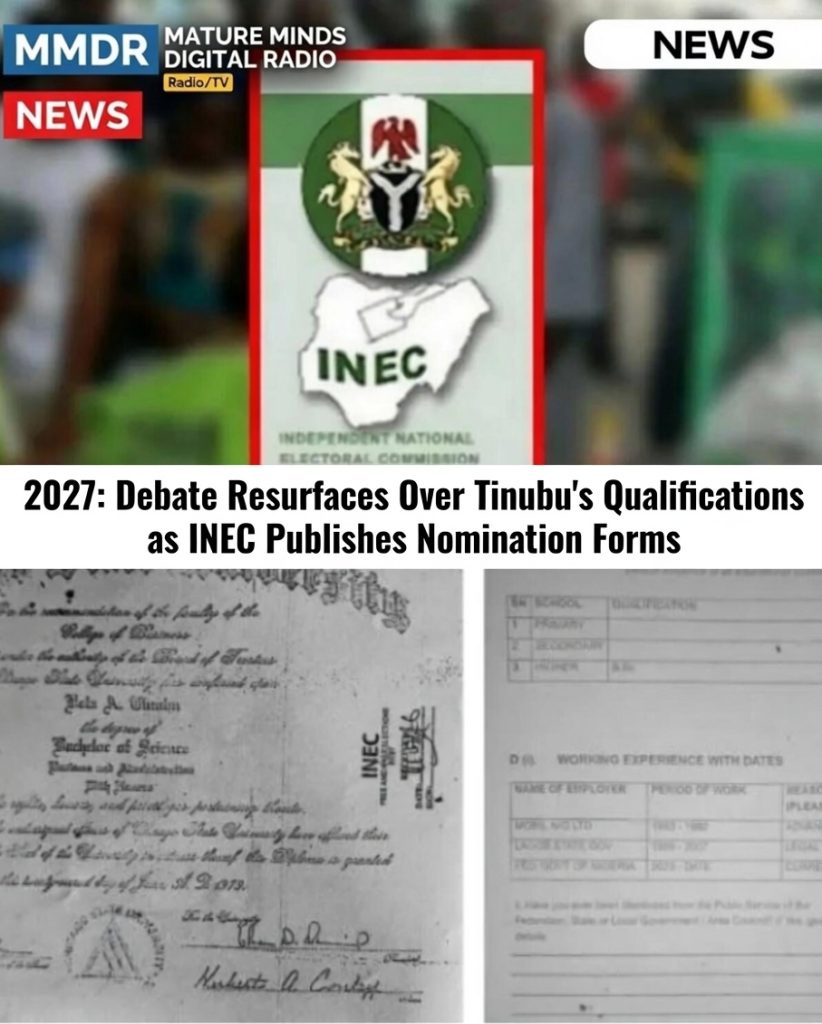
The Independent National Electoral Commission’s release of President Bola Ahmed Tinubu’s nomination documents for the 2027 election has reignited public debate over his educational background — an issue that dominated court cases after the 2023 polls.
INEC, which published the credentials of presidential candidates on Saturday, clarified that it does not verify the authenticity of certificates submitted. Its role, it said, is only to make them public for scrutiny.
According to the documents released, Tinubu listed only a Bachelor of Science in Business Administration from Chicago State University, 1979. The sections for primary and secondary school qualifications were left blank. He attached his BSc certificate and NYSC discharge certificate.
Other candidates’ forms showed different details.
Atiku Abubakar of the ADC listed a First School Leaving Certificate from 1954 and WASC from 1961, without naming schools, and an MA in International Relations from Anglia Ruskin University obtained in 2020.
Peter Obi of the NDC listed St. Augustine’s Primary School, Anambra (1973), Christ the King College (WASC 1978), and a BA in Philosophy from the University of Nigeria, Nsukka (1984).
The blank spaces on Tinubu’s form have revived the 2023 controversy, when Atiku alleged that Tinubu submitted a forged CSU diploma. Although CSU confirmed Tinubu graduated in 1979, questions over the specific diploma submitted to INEC were raised. Both the Presidential Election Petition Court and the Supreme Court dismissed the petitions and upheld Tinubu’s victory.
Legal experts split on implications
Senior Advocate Mumini Jimoh said secondary school education is a constitutional requirement, and its absence would be a “fundamental error.” But he believes it was likely an administrative mistake.
Another SAN, Mohammed Abeni, said skipping secondary school on the form creates suspicion. “You don’t jump from primary to university. The requirement is secondary school level, not university,” he noted.
Constitutional lawyer Danjuma John cited Section 318(1), saying “School Certificate or its equivalent” includes WAEC, Grade II Teacher’s Certificate, or other credentials approved by INEC.
But Taiye Oniyide (SAN) disagreed, saying there is no legal penalty. “The law does not say no secondary school certificate means no presidency. A university degree is higher,” he argued.
INEC: We only publish, not verify
INEC’s Deputy Director of Voter Education, Wilfred Osilama Ifogah, said the commission publishes candidates’ details “so the public can scrutinise.”
“It’s not the responsibility of the commission to verify the authenticity of credentials,” he said, citing the Electoral Act 2026.
Opposition reacts
The ADC, through spokesperson Bolaji Abdullahi, accused Tinubu of “hiding something,” saying the omission gives credence to long-standing rumours.
NDC’s Osa Director called it “strange,” adding that university admission is impossible without primary and secondary certificates.
Labour Party’s Ken Asogwa dismissed the concerns, saying the Electoral Act does not make primary and secondary certificates mandatory, and that Tinubu’s eligibility was already settled by the courts.
ADC presidential candidate Atiku Abubakarsaid the omission goes “to the heart of transparency and legitimacy.” In a statement by his aide Phrank Shaibu, he urged the Presidency to provide clear answers, warning that “a president whose records remain shrouded in controversy carries a burden of diminished moral legitimacy.”
Former Minister Solomon Dalung also challenged Tinubu on X: “If there is a reasonable explanation, Nigerians deserve to hear it. Public trust thrives on openness, not ambiguity.”
The APC’s spokesperson Felix Morka did not respond to requests for comment.
Background: The 2023 certificate case
In 2023, Atiku alleged Tinubu submitted a forged CSU diploma. The PEPC dismissed the case. Atiku then got a U.S. court to compel CSU to release records. CSU confirmed Tinubu graduated in 1979 but said it could not verify the specific diploma submitted to INEC.
A BBC fact-check found no evidence of forgery, noting replacement diplomas often differ. In October 2023, the Supreme Court dismissed Atiku’s appeal and affirmed Tinubu’s election.
